Drill Objective
Develop consistent technique, court awareness, and team communication in warm-up, ball control, defense, passing through high-repetition game-like execution.
Drill Setup & Court Layout
- Players: 6 players on the court in defensive base positions
- Coach: Positioned with a supply of balls to initiate free balls
- Court: Full court
- Equipment: Volleyballs, net
Step-by-Step Instructions
- Coach signals “Free ball” using whistle, hand clap, or verbal cue.
- All players transition off the net into their free ball positions.
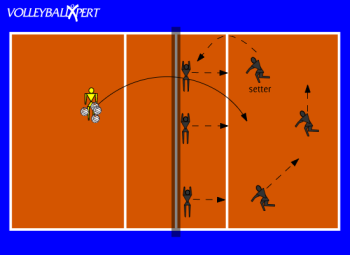
- While players are moving, coach tosses the free ball to one of the zones where a player should be positioned.
- The player in that position catches the ball, simulating first contact.
- Players return to defensive base positions and prepare for the next repetition.
- After a set number of reps (e.g., 6–8 free balls), rotate:
Front-row players move off the court.
Back-row players move into front-row positions.
New players rotate onto the back row. - Suggested reps: Each group should complete 10–12 transitions per round, and the drill lasts about 8–10 minutes.
Variations & Progressions
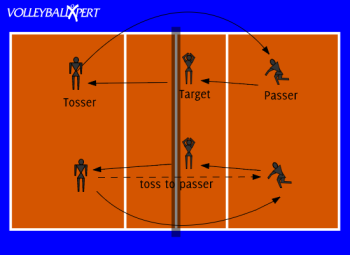
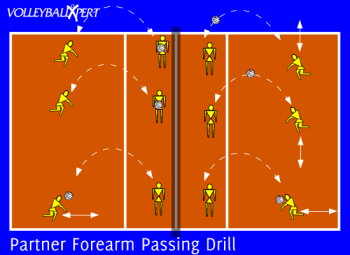
- Pass Instead of Catch: Players pass the ball to a target or back across the net instead of catching.
- Randomized Tosses: Coach mixes high, short, or angled tosses to force players to adjust quickly.
- Conditioning Add-On: Require players to complete a quick sprint to the end line after each transition.
Key Coaching Points
- Footwork: Watch for efficient footwork during transitions, not crossing or standing upright.
- Communication: Players must call “Mine!” on every free ball, and setters should loudly call “Free ball!” at the start of each play.
- Positioning Discipline: Emphasize correct spacing and angles during transitions.
- Consistency: Players should treat every rep with urgency as if in a game.
- Common Game Situation: Replicates real rallies where a team must quickly recognize a free ball, transition into offensive positions, and prepare for first contact.
This drill is excellent for early practice team training, setting the tone for disciplined transitions and clear communication.