Drill Objective
Train outside and opposite hitters to attack down the line with control while reinforcing setter rhythm and defensive transition positioning along the sideline.
Drill Setup & Court Layout
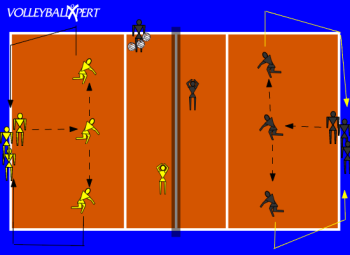
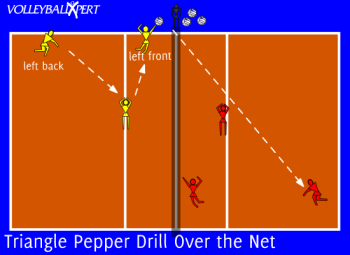
- Players: 3 players per side (Line Defender at Zone 5/1, Target Setter at Zone 2/3, and Outside Hitter at Zone 4).
- Court: Full court with standard net.
- Equipment: Ball cart at the net with the coach initiating play.
- Alignment: The line defender sets up directly opposite the cross-net hitter along the sideline channel.
Step-by-Step Instructions
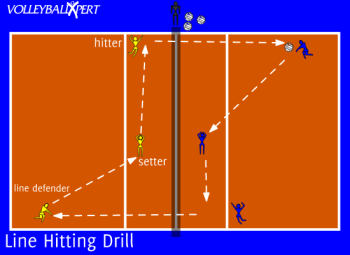
- Initiation: The coach tosses a free ball to the line defender on Side A.
- Pass to Setter: The line defender passes high to the target setter at the net.
- Line Set: The setter delivers a high-tempo set pushed out toward the antenna along the left sideline.
- Controlled Line Attack: The outside hitter approaches and hits a controlled roll shot or down-the-line attack directly at the opposing line defender on Side B.
- Continuous Transition: Side B executes the exact same pass-set-hit line sequence back to Side A to maintain a continuous cooperative rally.
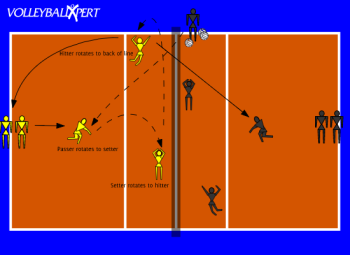
- Scoring/Rotation: Play to 10 consecutive line rallies, then rotate roles (Defender → Setter → Hitter → Rest/Off-Court).
Variations & Progressions
- Add Block Defense: Place a stationary blocker on the opposing side sealing cross-court to force the hitter to execute the line shot under visual pressure.
- Live Dig Progression: Transition from controlled roll shots to full jump-spike line attacks as defensive footwork improves.
- Right-Side (Zone 2) Mirror: Move hitters to right front (Zone 2) to practice opposite/right-side line attacking and setter back-sets.
Key Coaching Points
- Square Approach Angle: Attackers should maintain an approach angle facing cross-court, turning wrists and shoulders down the line at contact to disguise the shot.
- Contact at Peak Height: Reach high above the net and contact the top half of the ball with a firm wrist snap to keep the shot inside the sideline tape.
- Defensive Base on the Line: Line defenders must plant inside the court with shoulders angled inward so dug balls deflect toward the target setter rather than out of bounds.
- Setter Antenna Spacing: Setters must keep the ball 2–3 feet inside the antenna so the hitter has room to clear the net tape without attacking out.