Drill Objective
Develop consistent technique, court awareness, and team communication in ball control, defense, hitting, offense, passing, pass-set-hit, serve defense, serving, setting through high-repetition game-like execution.
Drill Setup & Court Layout
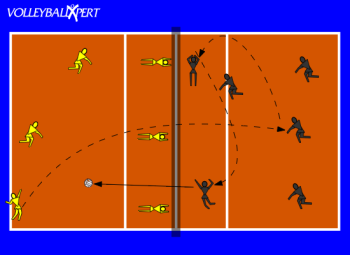
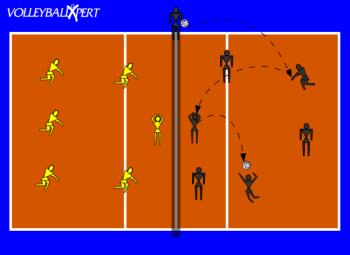
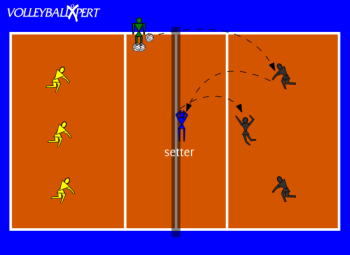
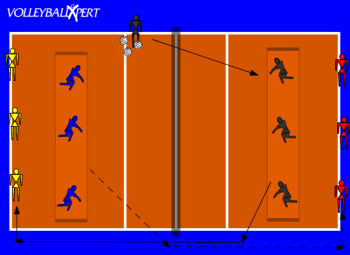
- Players: Teams of 3 (two active on each side, additional teams waiting behind serving lines)
- Coach: Positioned on the sideline with a supply of volleyballs to initiate play
- Court: Full court, with the 10-foot line enforced as an attack boundary
- Equipment: Volleyballs, net
Step-by-Step Instructions
- Form multiple teams of 3 players each. Two teams begin on the court, one per side, with others waiting behind each serving line.
- Coach initiates play with a free ball toss.
- Teams must complete pass, set, and hit sequences while staying behind the 10-foot line for all attacks.
- After a successful rally, the ball is sent over the net, and the team that just attacked rotates off and goes behind the opposite baseline.
- If a team makes an error (missed pass, illegal attack, out of bounds, or failure to stay behind the 10-foot line), they are eliminated and replaced by the next team in line.
- When only two teams remain, they play one final rally to determine the winner.
- Award 1 point to the winning team of that round.
- Suggested reps: Play until a team earns 5–7 points, or for 12–15 minutes total.
Variations & Progressions
- No Elimination: Instead of elimination, rotate teams off after each rally.
- Serve Start: Begin with a serve instead of a coach’s toss for added realism.
- Target Zones: Require attackers to aim for specific zones (deep corner, seam, line).
Key Coaching Points
- Back Row Rule: Ensure hitters leave the ground from behind the 10-foot line.
- Controlled Tempo: Encourage high, controlled sets to allow consistent back row swings.
- Teamwork: Players must communicate clearly to execute clean pass-set-hit sequences.
- Decision-Making: Hitters should aim for placement over raw power.
- Common Game Situation: Mimics back row attacking sequences in real matches, reinforcing rule compliance, tempo, and attacking strategy from deep court positions.
This is a fun and competitive drill that combines skill development with teamwork and tactical back-row offense.